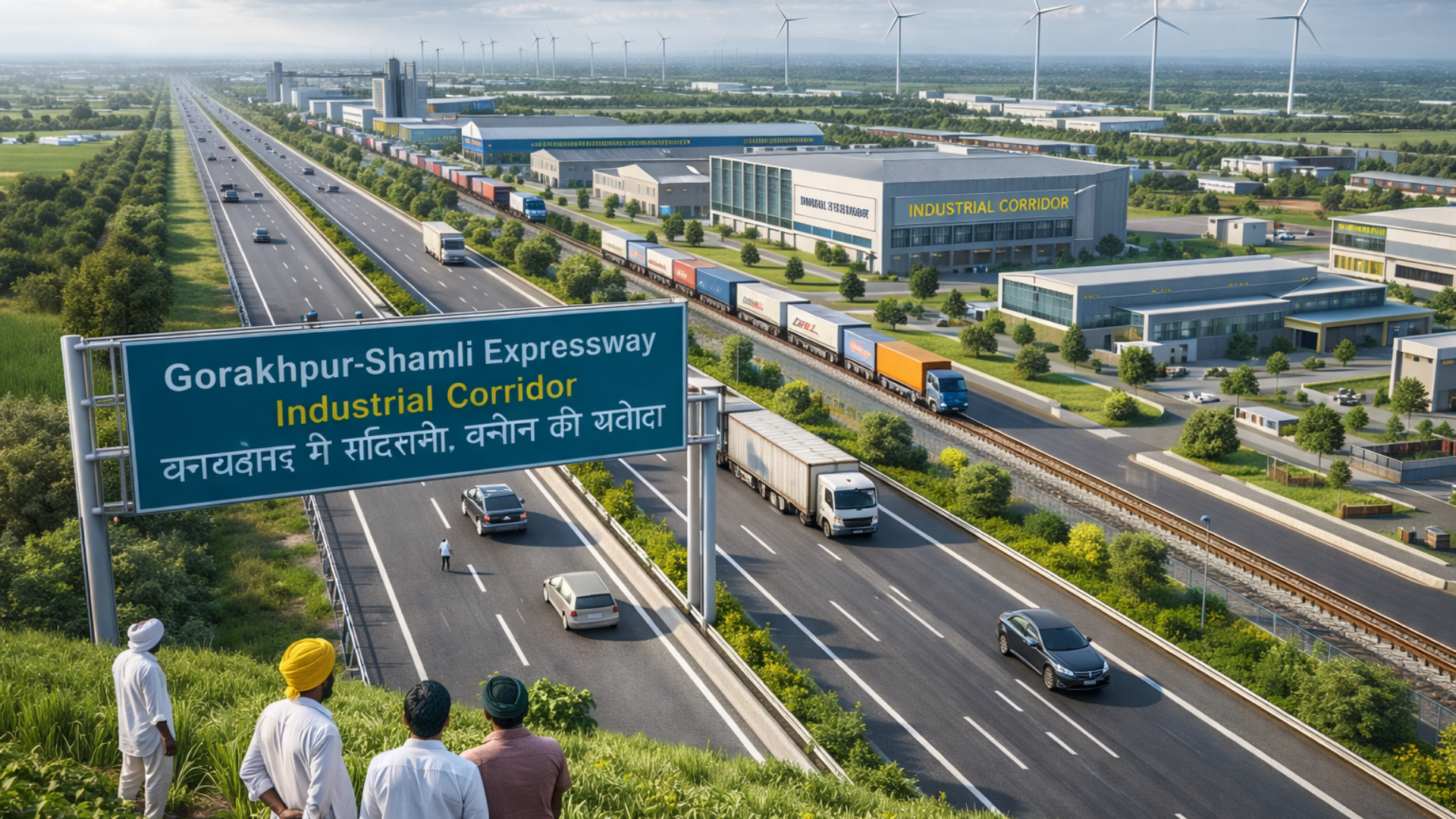
The Government has taken a major step towards boosting industrial development and employment by planning a new industrial corridor on the Gorakhpur-Shamli Expressway. Under this project, farmers will give their land on lease instead of selling it, which has created strong interest and discussion among rural communities. This model is being seen as farmer-friendly because landowners will continue to remain owners of their land while earning regular income through lease payments. The industrial corridor is expected to attract big investments, create jobs, and improve infrastructure in the surrounding regions.
Gorakhpur-Shamli Expressway
Gorakhpur-Shamli Expressway Industrial Corridor Plan
The Gorakhpur-Shamli Expressway is one of the most important upcoming expressways, connecting eastern and western parts of the state. Along this expressway, the government is planning to develop a large industrial corridor to promote manufacturing, logistics, warehouses, and small-to-large industries. The main objective of this corridor is to utilize the expressway’s connectivity to attract industries and reduce regional imbalance. Industrial plots, business parks, and supporting infrastructure will be developed in a planned manner so that industries can easily operate and expand.
Land on Lease Model for Farmers
Unlike traditional land acquisition methods, this project will follow a land leasing model. Farmers will not have to sell their land permanently. Instead, they can give their land on lease for a fixed period, such as 30 to 60 years, depending on the agreement. During this time, farmers will receive regular lease rent, which will act as a steady source of income. After the lease period ends, the land rights will remain with the farmers or their families. This approach reduces fear among farmers and ensures long-term financial security.
Compensation, Lease Rent and Financial Benefits
Under the lease model, farmers are expected to receive attractive compensation in the form of annual or monthly lease payments. The lease amount will be decided based on land location, size, and market value. In many cases, the lease income can be higher and more stable than traditional farming income. Additionally, some farmers may also get one-time bonuses, skill development support, or priority in employment opportunities within the industrial corridor. This financial stability can help improve living standards in rural areas.
Employment and Development Opportunities
The industrial corridor on the Gorakhpur-Shamli Expressway is expected to create thousands of direct and indirect jobs. Local youth will get opportunities in factories, warehouses, transport services, security, maintenance, and other support roles. Small businesses such as shops, food services, and housing rentals will also grow around the corridor. This development will help reduce migration to big cities and promote local economic growth.
Infrastructure Growth and Regional Impact
With the development of the industrial corridor, nearby villages and towns will see rapid infrastructure growth. Better roads, electricity, water supply, internet connectivity, schools, and healthcare facilities are likely to improve. The expressway itself will make transportation of goods faster and cheaper, benefiting industries and farmers alike. Over time, the region around the Gorakhpur–Shamli Expressway could transform into a major economic hub.
Government Support and Transparency Measures
The government has assured that the entire leasing process will be transparent and farmer-friendly. Proper agreements, legal protection, and grievance redressal systems will be put in place. Awareness programs and meetings will be conducted to explain the lease terms clearly to farmers. This approach aims to build trust and ensure that farmers fully understand their rights and benefits before giving land on lease.
Conclusion: A Win-Win Model for Farmers and Industry
The decision to develop an industrial corridor on the Gorakhpur–Shamli Expressway using a land lease model is being seen as a win-win solution. Farmers get regular income without losing land ownership, while industries get access to strategically located land with excellent connectivity. This balanced approach can set an example for future infrastructure and industrial projects across the country. If implemented properly, this project has the potential to change the economic landscape of the region and improve the lives of thousands of farmers and families.