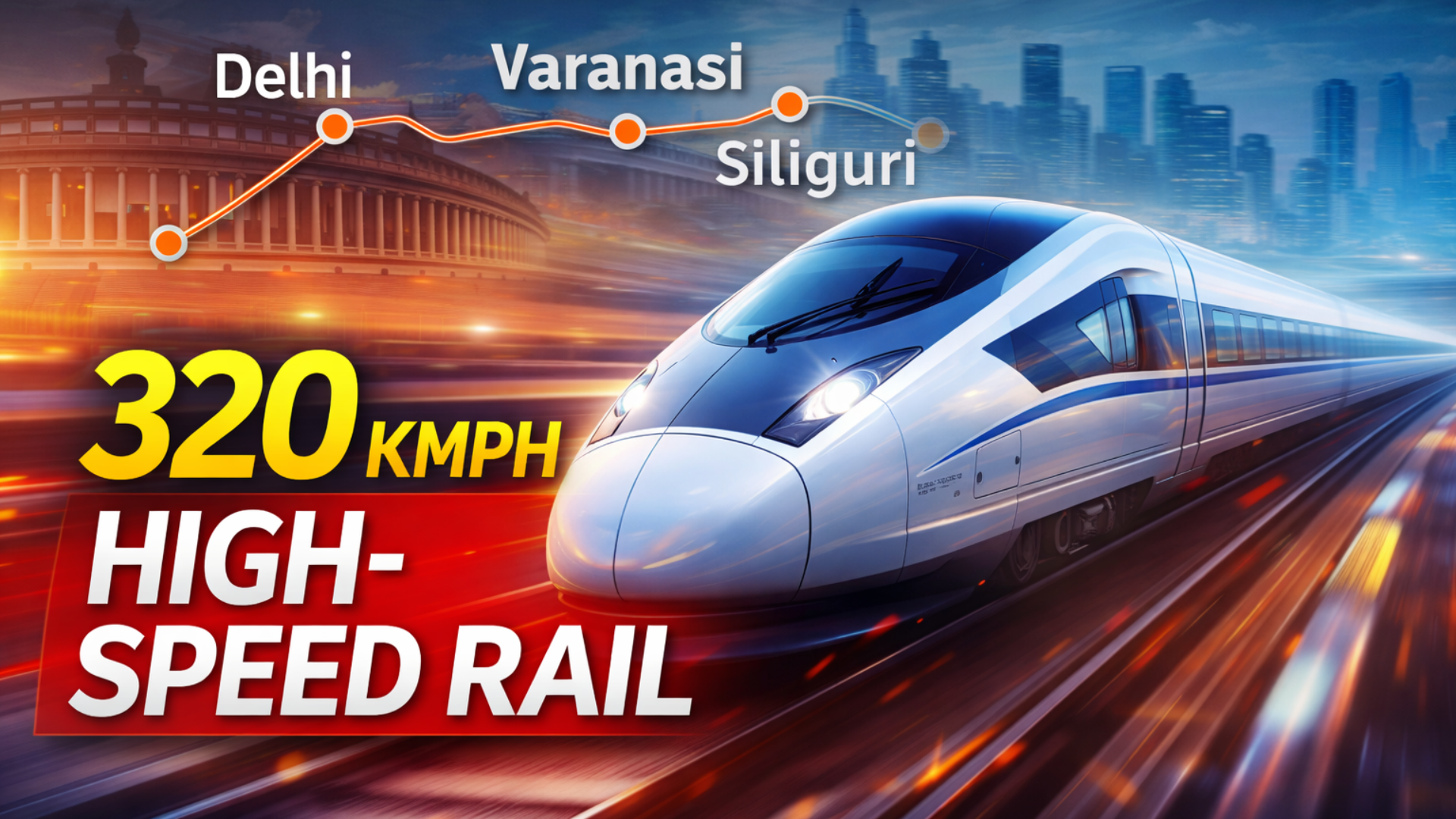
India’s railway infrastructure is moving towards a new era with the announcement of a high-speed rail project that will run at a top speed of 320 kmph. This rail gift for Delhi is not limited to the capital alone, as it will also bring massive benefits to Uttar Pradesh and Bihar. The proposed high-speed corridors, including Delhi-Varanasi and Varanasi-Siliguri, are expected to transform travel, reduce journey time and boost economic growth across North India.
Delhi-Varanasi and Varanasi-Siliguri
High-Speed Rail Project with 320 Kmph Speed
The upcoming high-speed rail project is designed to operate trains at an impressive speed of up to 320 kmph. This speed is similar to bullet train projects and will be one of the fastest rail services in India. With advanced technology, modern tracks and high-level safety systems, these trains will offer a world-class travel experience.
The main aim of this project is to reduce long travel hours and provide faster connectivity between major cities. Passengers will be able to travel comfortably in less time, making rail travel a strong alternative to flights for medium-distance routes.
Delhi-Varanasi Corridor: A Game Changer
One of the most important routes in this project is the Delhi-Varanasi high-speed rail corridor. Currently, traveling between Delhi and Varanasi takes several hours by train. With the new high-speed rail, this travel time is expected to reduce drastically.
This corridor will connect the national capital with one of the most important cultural and spiritual cities of India. Faster connectivity will help tourists, business travelers and daily passengers. It will also reduce pressure on existing railway routes and highways.
Varanasi-Siliguri Corridor: Boost for East India
Another major corridor included in this project is the Varanasi–Siliguri high-speed rail route. This corridor is very important as it connects eastern Uttar Pradesh, Bihar and North Bengal. Siliguri is known as the gateway to Northeast India, and better connectivity will help trade and tourism.
For Bihar, this corridor will be a major development step. Cities and towns along the route will get faster access to major markets and opportunities. Improved rail connectivity is expected to support local businesses and improve overall regional development.
Big Benefits for Uttar Pradesh and Bihar
Although the project is being highlighted as a major rail gift for Delhi, Uttar Pradesh and Bihar are among the biggest beneficiaries. High-speed rail stations along these corridors will create new development zones. Property values, employment opportunities and business activities are likely to increase. Students, working professionals and small traders will benefit from faster travel. The improved connectivity will also help in better access to healthcare, education and government services across regions.
Modern Technology and Passenger Comfort
The 320 kmph high-speed trains will be equipped with modern technology and premium passenger facilities. These trains are expected to offer comfortable seating, advanced safety features and smooth rides even at high speeds. Special focus will be given to punctuality, cleanliness and passenger convenience. With modern stations and digital ticketing systems, the overall travel experience will be much better compared to traditional trains.
Economic Growth and Employment Opportunities
The construction and operation of high-speed rail corridors will create thousands of direct and indirect jobs. From construction workers to engineers and service staff, the project will generate employment at multiple levels. In the long term, faster connectivity will boost tourism, trade and investment. Cities connected by high-speed rail often see rapid economic growth due to improved accessibility and reduced travel time.
Environmental and Infrastructure Impact
High-speed rail is considered more environmentally friendly compared to road transport and short-distance flights. By shifting passengers from roads and air to rail, this project can help reduce pollution and fuel consumption. The project will also encourage better urban planning around stations. New infrastructure such as roads, hotels and commercial complexes is expected to develop near high-speed rail stations.
The 320 kmph high-speed rail project connecting Delhi, Varanasi and Siliguri is a major step towards modernizing India’s railway system. While Delhi receives a big rail gift, the real impact will be felt across Uttar Pradesh, Bihar and eastern regions.
With faster travel, better connectivity and economic growth, this project has the potential to change the way people travel in North and East India. Once completed, these high-speed corridors will mark a new chapter in India’s transport and infrastructure development.